
You arrive early for a track workout or local race and see runners moving through A-skips, high knees, and heel flicks. Some look polished. Others look unsure. It is reasonable to wonder: Should I be doing those too?
Running drills can be useful for practicing rhythm and coordination before faster running, but they are optional. In this guide, you will learn what the common drills are meant to practice, how to perform them without exaggerating the movement, which variations are appropriate for beginners, and what the research does—and does not—show.
Quick answer: You do not need running drills to become a capable distance runner. If they help you feel coordinated before a faster session, keep the routine brief and controlled. Before an easy run, starting gently may be all the preparation you need.
Prefer to listen?
Do running drills actually make you a better runner? In Episode 32 of the Half Marathon Training Plan Podcast, Coach Chris and Coach Maya explore what the research says about running drills, running economy, and injury prevention—and whether recreational runners really need them.
Listen to Episode 32: Do Running Drills Actually Make You a Better Runner?
What are running drills?
Running drills are short, repeated movements that exaggerate or isolate one part of a running-like action. Examples include A-marches, A-skips, B-skips, ankling, high-knee marches, and heel flicks. Coaches often use them to give an athlete a simple movement task—such as coordinating opposite arm and leg action or finding a steady rhythm—before a workout.
The useful goal is practice, not a perfect-looking pose. A drill changes the speed, range of motion, contact pattern, or rhythm of normal running. Performing a movement in isolation does not guarantee that your body will use it automatically at your usual running pace.
Drills, warm-ups, and strength training are different
A warm-up is the gradual preparation for the session ahead. Depending on the workout and the runner, that may mean a few minutes of easy jogging or brisk walking followed by comfortable dynamic movement. Drills can be one optional part of that preparation, especially before faster running, but they are not a required warm-up and do not replace gradual preparation.
Strength training uses progressive resistance—such as body-weight exercises, weights, or resistance bands—to challenge muscles and connective tissues over repeated sessions. Evidence that structured strength or plyometric training can affect running economy is not evidence that a few A-skips have the same effect. A short drill set also cannot replace easy mileage, long runs, recovery, or a strength plan when one is appropriate.
What does the research say about running drills?
The evidence specific to A-skips, B-skips, and similar drills is limited. The clearest practical conclusion is that drills may be used as movement practice, but they should not be sold as a proven shortcut to better economy, faster race times, or fewer injuries.
Direct drill research: In a 15-week study of 30 recreational runners, both groups completed interval training, while one group also performed running drills. The drill group did not improve running performance compared with the control group, and some mechanical-load measures were higher. That small study does not settle every question about drills, but it does not support a guaranteed performance benefit [1].
A laboratory study compared A-skips, B-skips, bounding, heel flicks, and straight-leg running with distance running in 17 runners. Several drills produced different foot-and-ankle motion or power patterns from running. The study helps describe what the drills load and rehearse; it did not test whether practicing them improves performance [2].
Related evidence: Research on running biomechanics, gait retraining, and strength training provides useful context, but those topics are not interchangeable with a short drill routine. A systematic review found mostly small or inconsistent relationships between individual biomechanical features and running economy, and observational associations do not prove that changing a movement causes improvement [3]. A gait-retraining review found that structured interventions can change selected mechanics, while performance effects were not demonstrated overall [4]. Multiweek strength programs are a separate training method with their own evidence base [5].
Running drills at a glance
| Drill | Beginner level | Coaching purpose | Key cue |
|---|---|---|---|
| A-march | Beginner | Practice posture and opposite arm-leg timing | Place the foot beneath the hips |
| A-skip | Beginner to intermediate | Add rhythm and a small skipping action | Skip lightly; do not jump for height |
| B-skip | Intermediate or optional | Explore swing-to-ground timing | Gently unfold, then sweep down under control |
| Ankling | Beginner | Practice compact, quick foot contacts | Use small steps and low knees |
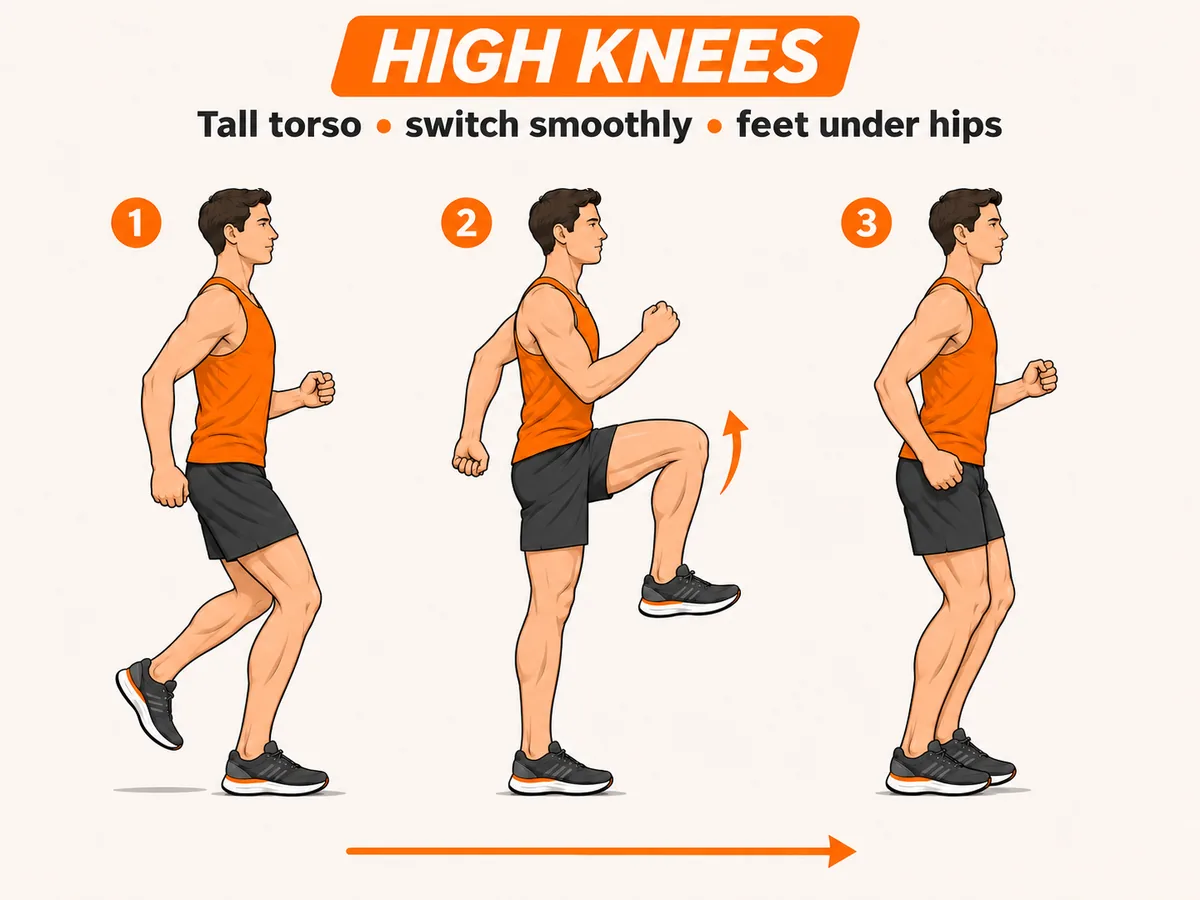
| High knees | Beginner march; faster version intermediate | Practice controlled knee lift and switching | Stay tall and place the foot beneath you |
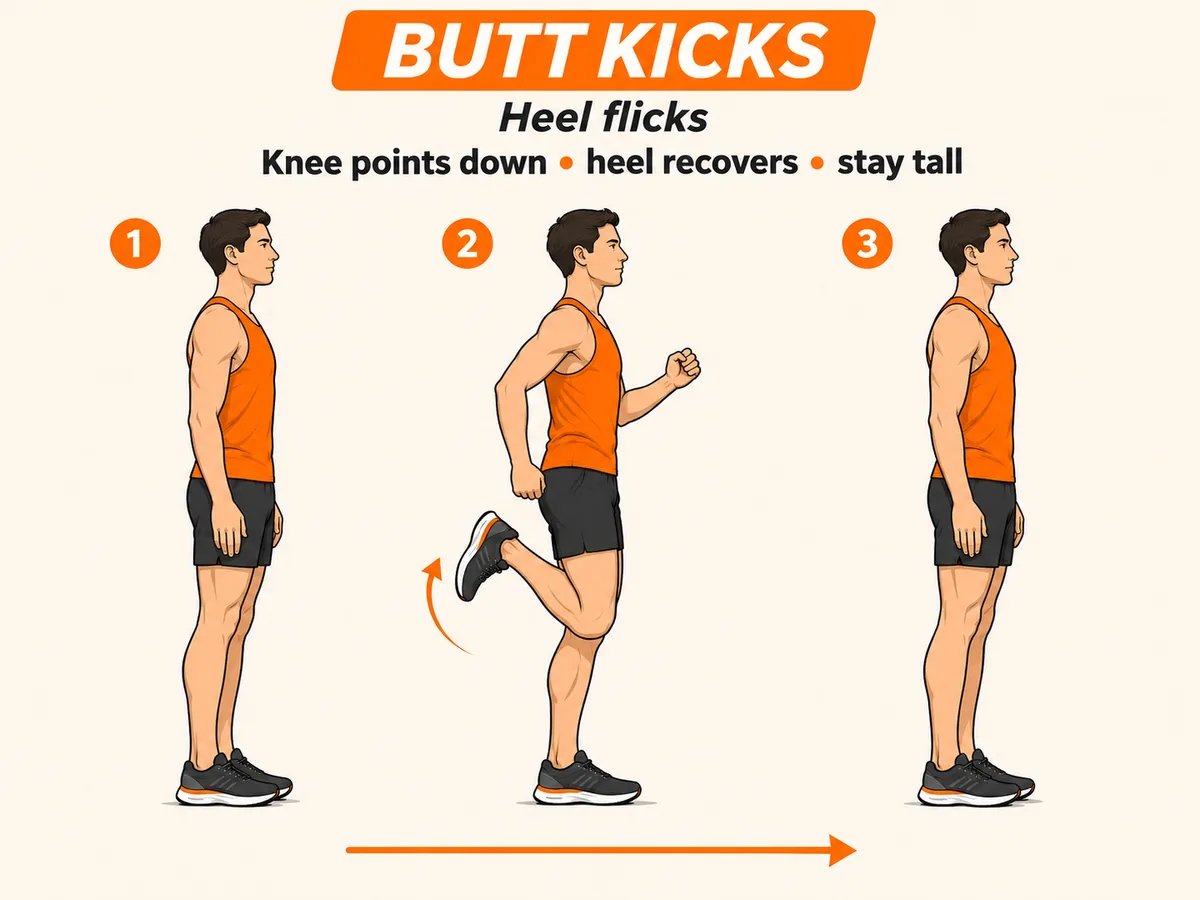
| Butt kicks | Beginner | Practice heel recovery with the knee pointing down | Use a comfortable range; do not force heel to glute |
On a small screen, swipe horizontally to view all four columns.
A-march: the beginner starting point
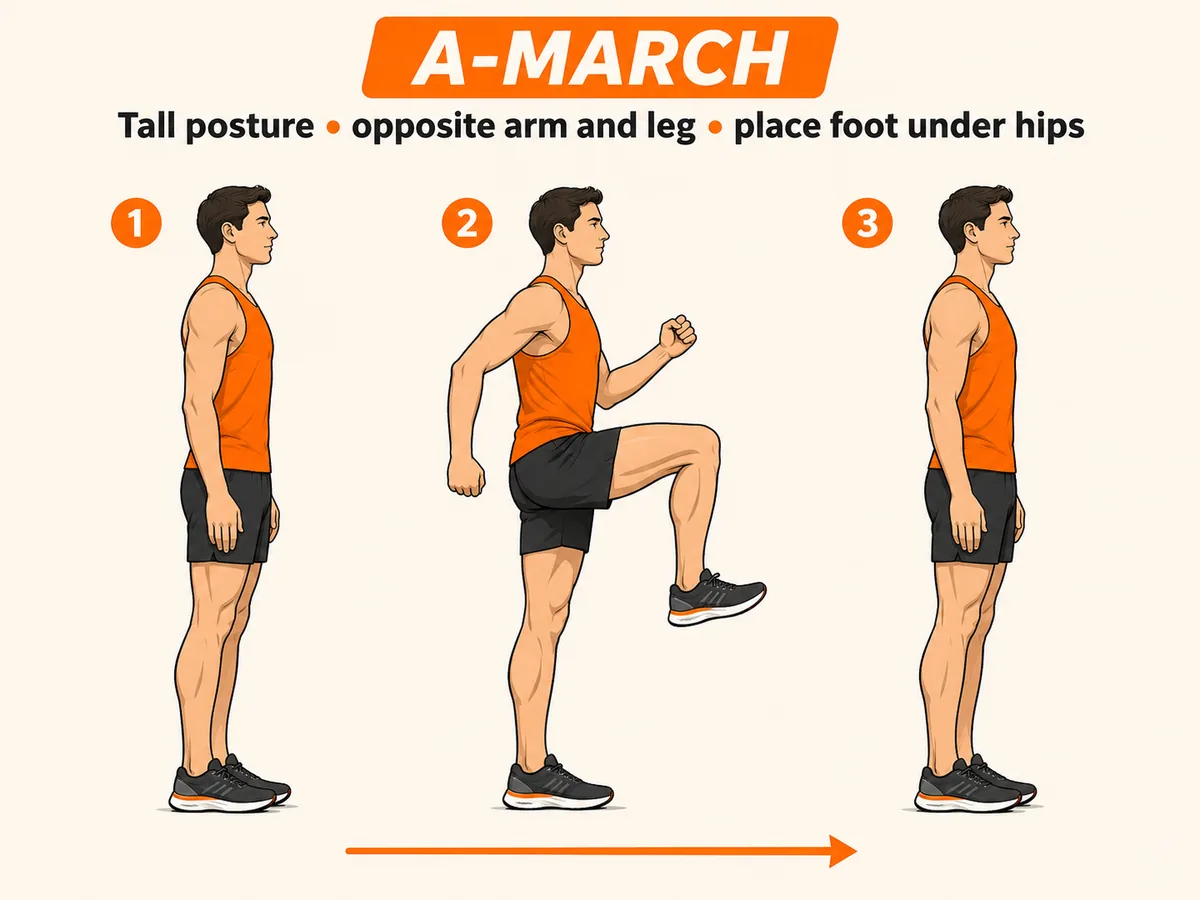
The A-march is the simplest way to learn the rhythm before adding a hop. It practices tall posture and opposite arm-and-leg timing at a speed you can control.
- Stand tall with your shoulders relaxed and eyes ahead.
- Lift one knee to a comfortable height while the opposite arm moves forward.
- Keep the ankle gently flexed so the toes are not pointing at the ground.
- Place the foot back beneath your hips, then switch sides.
Common mistakes: leaning backward, lifting the knee as high as possible, reaching the foot forward, or stiffening the shoulders.
A-skip: rhythm and coordination
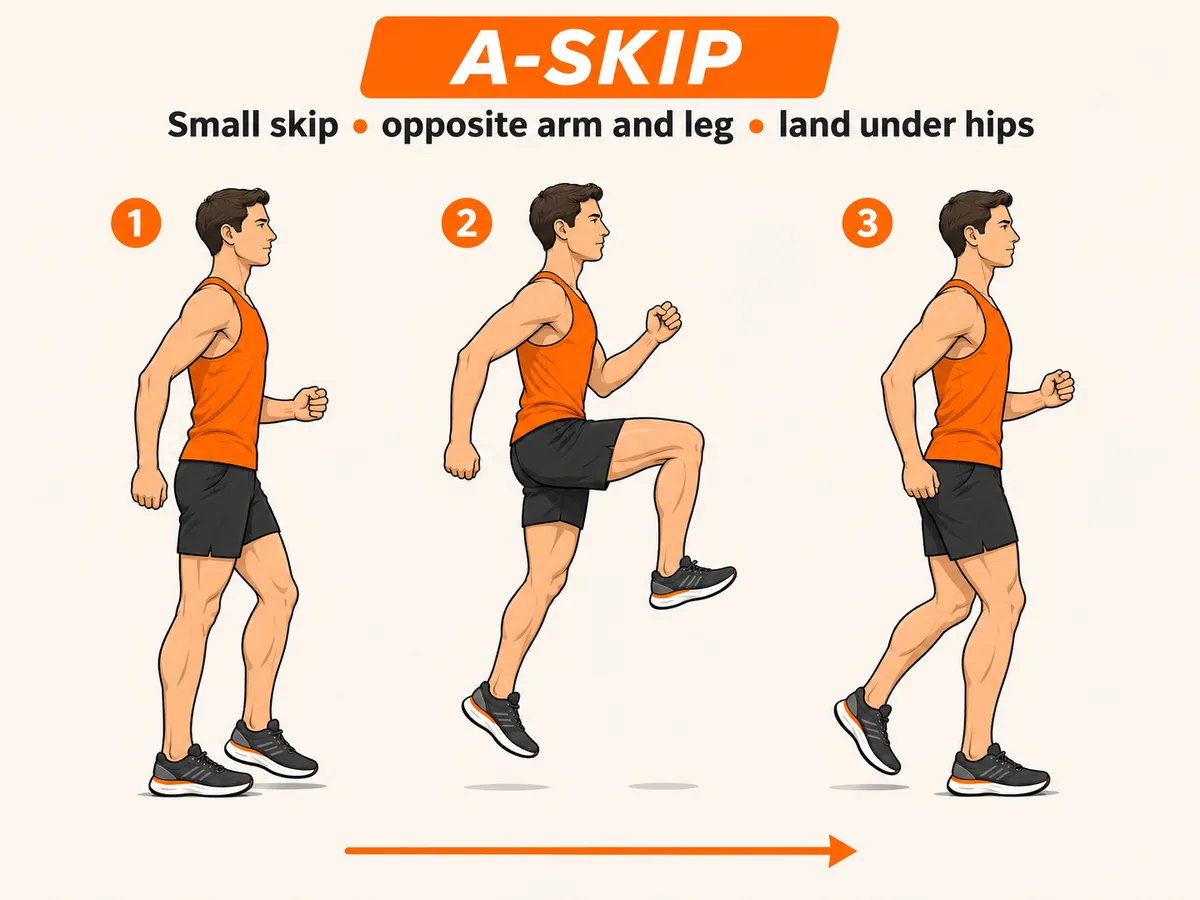
An A-skip adds a small hop to the alternating knee lift. Coaches commonly use it to practice rhythm, posture, and opposite arm-and-leg timing. Those are coaching aims, not guaranteed improvements to running form or race performance.
- Begin with a relaxed A-march.
- Add a small skip from the supporting foot as the opposite knee rises.
- Keep the movement light rather than jumping for height.
- Let the lifted foot return beneath you, then switch sides in a steady rhythm.
- Travel only a short distance, then walk back and reset.
Common mistakes: jumping too high, leaning backward, reaching the foot far in front, or speeding up before the rhythm feels smooth. If skipping is uncomfortable, stay with the A-march.
B-skip: an advanced variation with limits
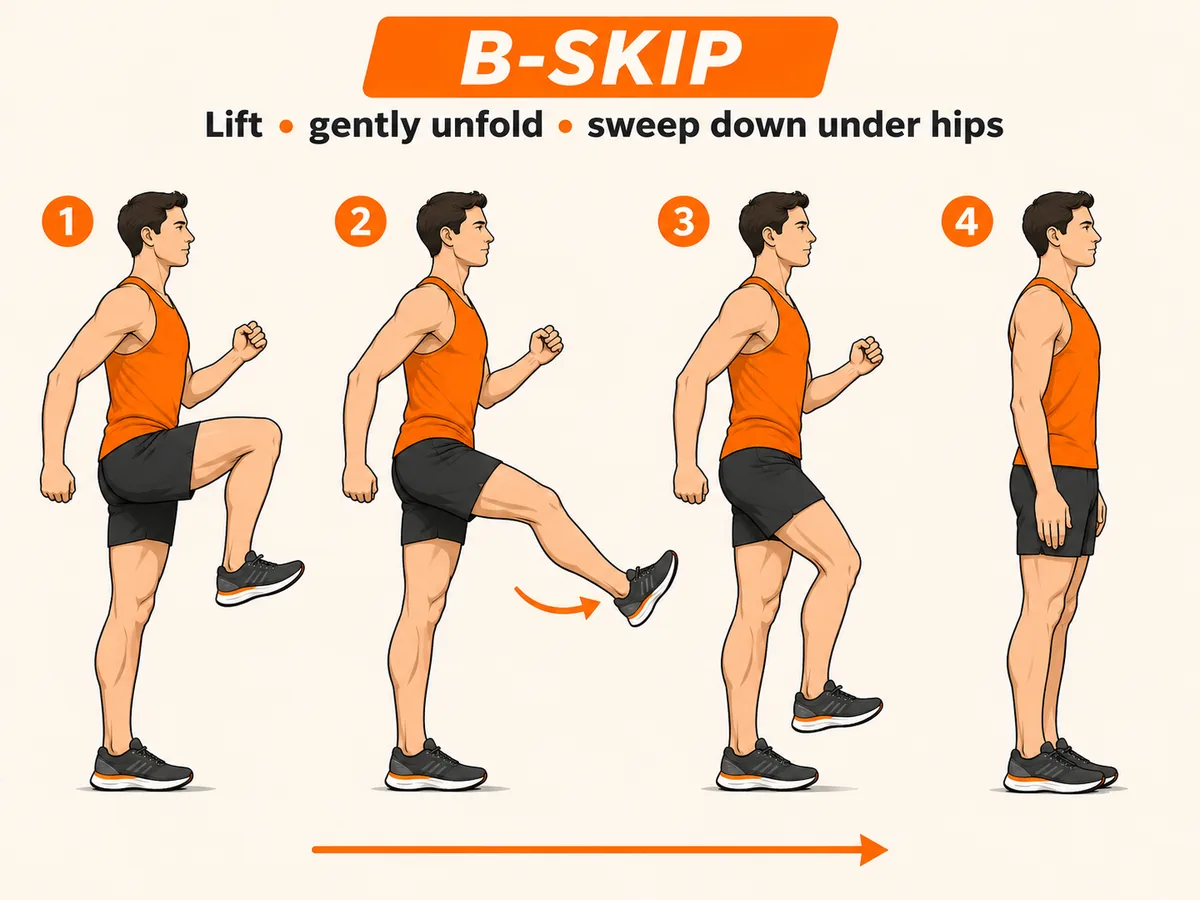
A B-skip adds a modest lower-leg extension after the knee lift, followed by a controlled downward and backward action. Coaches sometimes use it to explore timing through the swing-to-ground phase. It is more complex than an A-skip and is not essential for distance runners.
- First perform a relaxed A-march or A-skip without losing balance.
- Lift the knee comfortably, then let the lower leg unfold only a little in front of you.
- Keep the foot relaxed and avoid locking the knee.
- Bring the foot down under control; think “light and close” rather than kicking or reaching.
- Use a slow rhythm over a few meters and stop if you feel pain or strain.
Common mistakes and limitations: snapping the lower leg straight, reaching the foot far ahead, turning the movement into a high-impact bound, or assuming the action should be copied into every running stride. Beginners can skip B-skips entirely and still train effectively.
Ankling or ankle dribbles
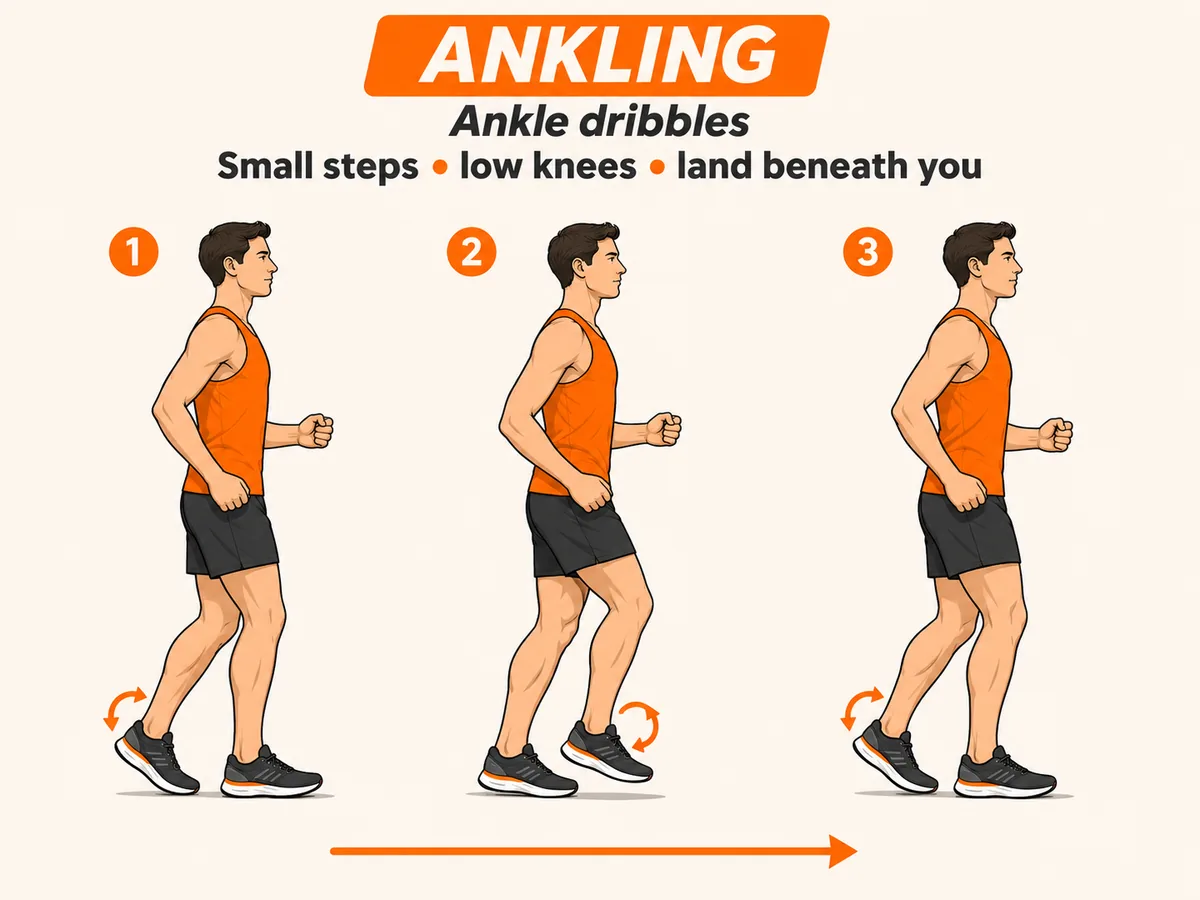
Ankling uses small, quick steps with minimal knee lift. Keep the steps relaxed and let each foot contact the ground close beneath your body. The aim is a compact rhythm, not bouncing as high as possible or staying rigid through the ankle.
Common mistakes: rising onto the toes and bouncing vertically, taking long steps, locking the knees, or forcing the ankles to stay stiff.
High knees
High knees can mean anything from a controlled march to a fast running drill. Most recreational runners should start with the lower-intensity version. Keep your torso tall, lift each thigh only as high as is comfortable, and place the foot back beneath your hips. Let your arms move naturally in opposition to your legs.
Common mistakes: leaning backward, chasing maximum knee height, landing with the foot well ahead of the body, or turning the drill into an exhausting sprint.
Butt kicks or heel flicks
Butt kicks bring the heel toward the back of the thigh while moving forward or in place. Use a comfortable range and keep the knee pointing generally down. Your heel does not need to touch your glute. This drill does not strengthen the hamstrings in the same way resistance training does.
Common mistakes: arching the lower back, driving the knee far forward, forcing the heel higher than is comfortable, or rushing until posture breaks down.
Which drills are suitable for beginners?
Beginners can start with movements that are easy to control:
- A-march before adding a hop
- Low-amplitude ankling or ankle dribbles
- Comfortable high-knee marching
- Gentle heel flicks, if they feel natural
A-skips are a reasonable next step if marching and skipping are comfortable. B-skips and bounding-style drills ask for more timing and force; they are optional. If you are returning from an injury, have current pain, or are unsure whether a movement is appropriate, get individualized advice from a qualified clinician or coach.
When and how often should you practice?
There is no well-established minimum dose or ideal weekly frequency for recreational runners. If you want to try drills, begin with one short practice per week before a faster workout. Do them after a general warm-up and before the demanding part of the session, while you are fresh.
Try one or two passes of 10–15 meters for one or two drills. Walk back to recover and stop before the movement gets sloppy. Skipping and bounding still add impact, so introduce them gradually. If the drills make you tired, sore, or anxious about your form, remove them. The same patient approach applies whenever you add training stress; HMTP explains the broader principle in why runners can get injured just as training starts to feel easier.
An optional 5–10-minute drill sequence
The entire practice takes approximately 5–10 minutes when you include transitions, walk-back recovery, and time to reset between passes. The drill movements themselves are brief. Choose fewer repetitions when you are learning them.
- A-march: 1–2 × 10–15 meters, relaxed.
- Ankling: 1–2 × 10–15 meters, with short, quiet steps.
- A-skip: 1–2 × 10–15 meters, only if the march and skip feel comfortable.
- Walk back and reset between passes. Finish feeling coordinated, not winded.
An experienced runner who already performs B-skips comfortably may substitute one short B-skip pass for the A-skip. You do not need to add every drill. Before an easy run, you can skip this sequence and simply begin at a gentle pace.
When can you skip drills?
You can skip drills whenever they do not serve a clear purpose. Leave them out when you are short on time, preparing for an easy run, learning to run consistently, fatigued, or managing discomfort. A few minutes of drills will not compensate for inadequate recovery or an abrupt increase in training.
If drills make you feel that your natural stride is wrong, step away from the cues. Most runners do not need to consciously micromanage every foot strike, knee angle, or arm swing. If pain persists or changes how you run, stop the provoking movement and seek appropriate medical guidance.
Common misconceptions about running drills
- “Drills prevent running injuries.” Drill-specific research does not establish that they prevent injuries. Do not use them as a substitute for sensible progression, recovery, or care for persistent pain.
- “A-skips automatically improve running economy.” Observational links between some biomechanical traits and running economy do not show that a drill causes better economy.
- “The drill is exactly how you should run.” Drills deliberately alter movement. The mechanics are not identical to ordinary distance running.
- “More drills mean better technique.” Extra repetitions add time and impact without a demonstrated benefit for every runner.
- “Every runner needs B-skips.” B-skips are a coaching option, not a half-marathon prerequisite.
The practical takeaway
Use running drills only when they make the next part of training clearer. One or two controlled movements before a faster session can be enough. Keep the range comfortable, stop while the rhythm is still clean, and leave the routine out when it creates more fatigue or complexity than value.
The work that prepares you for a half marathon is still the repeatable work: appropriate mileage, gradual long runs, recovery, and a plan you can follow consistently. HMTP’s free 14-week half-marathon training plan provides that structure for beginner and returning runners. You can also visit Start Here for HMTP’s training resources, podcast, and practical guidance.
References
- Azevedo, A. P. S., Mezêncio, B., Valvassori, R., Anjos, F. O. M., Barbanti, V. J., Amadio, A. C., & Serrão, J. C. (2015). Usage of running drills in an interval training program: Implications related to biomechanical parameters of running. Journal of Strength and Conditioning Research, 29(7), 1796–1802. Direct drill-intervention study.
- Abran, G., Berraz, A., Dardenne, N., Gramage, K., Bornheim, S., Delvaux, F., Croisier, J.-L., & Schwartz, C. (2025; published online 2024). A comparison of foot and ankle biomechanics during running drills and distance running. Sports Biomechanics, 24(7), 1974–1989. Direct acute-biomechanics study; not a training trial.
- Van Hooren, B., Jukic, I., Cox, M., Frenken, K. G., Bautista, I., & Moore, I. S. (2024). The relationship between running biomechanics and running economy: A systematic review and meta-analysis of observational studies. Sports Medicine, 54(5), 1269–1316. Related observational evidence; not a drill study.
- Doyle, E., Doyle, T. L. A., Bonacci, J., & Fuller, J. T. (2022). The effectiveness of gait retraining on running kinematics, kinetics, performance, pain, and injury in distance runners: A systematic review with meta-analysis. Journal of Orthopaedic & Sports Physical Therapy, 52(4), 192–206. Related gait-retraining evidence; not a drill study.
- Llanos-Lagos, C., Ramirez-Campillo, R., Moran, J., & Sáez de Villarreal, E. (2024). Effect of strength training programs in middle- and long-distance runners’ economy at different running speeds: A systematic review with meta-analysis. Sports Medicine, 54(4), 895–932. Related strength-training evidence; not a drill study.